Layer III · Essay
The Long Quiet: on memory, absence, and the spirit that will not leave the stage.
Noh is the only theatrical form I know in which the protagonist is, more often than not, already dead before the curtain rises — and in which this fact is not a twist but the entire premise.
Memory as performance
To remember, in the Western metaphysical tradition, is to retrieve. The memory is somewhere — in the brain, in the archive, in the soul — and the act of remembering is the act of returning to fetch it. Noh proposes a different model. To remember is to perform: to give the lost thing a body again, briefly, in front of witnesses, so that it can finish whatever gesture it was making when it was interrupted.
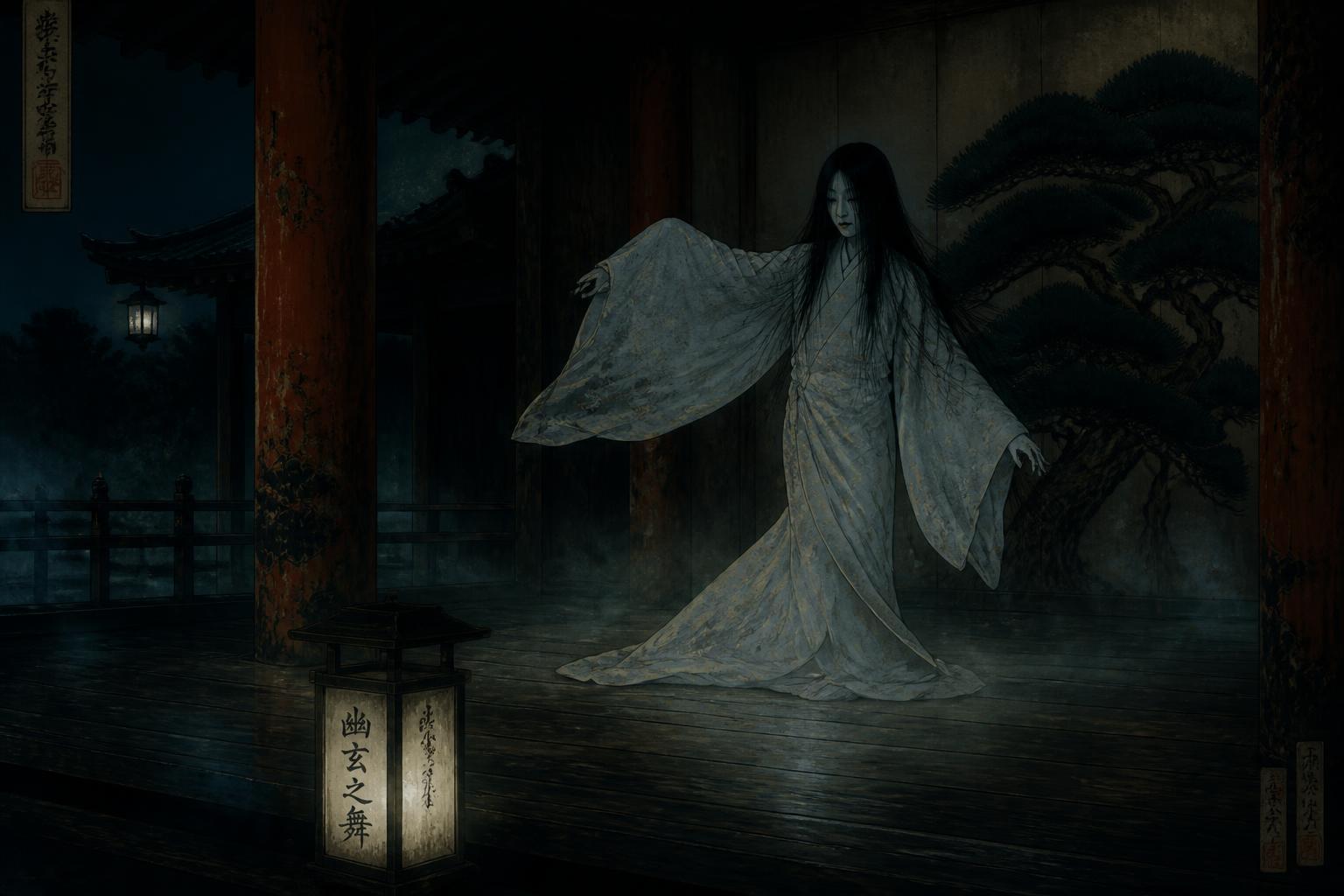
The two-act dream play, mugen-nō, is built around this structure. A traveller arrives at a place — a battlefield, a temple, a stretch of river — and meets a stranger who tells him a story about an event that happened there long ago. In the interval, the traveller sleeps. In the second act, the stranger returns, no longer disguised, and dances the event itself. The performance is the memory: not its description, not its trace, but its enactment. When the dance ends, the ghost can go.
夢の中の能
"In dream-Noh the act of memory is not the recollection of the dance — it is the dance."
Absence as positive form
The stage on which this happens is almost empty. A polished cypress floor, twenty feet square. A painted pine on the back wall. Four pillars. A bridge (hashigakari) extending stage-left into a curtained passage from which the actors come. There is no scenery. There is no proscenium. The lighting, traditionally, is whatever falls from the eaves.
This emptiness is not minimalism in the Western sense — it is not the subtraction of decoration to reveal an essential thing. It is the cultivation of a space that can be inhabited by what is no longer there. In Sōtō Zen, the philosopher Dōgen wrote that "to be enlightened by the ten thousand things is to drop off body and mind." The Noh stage is the architecture of a body that has been dropped off.
The aesthetic concept here is ma (間) — the loaded interval — but ma is only legible if one has stopped treating absence as a deficit. Western dramaturgy tends to ask: what happens? Noh asks: what remains?
Spirituality without doctrine
Noh emerged in the late fourteenth century from a confluence of Pure Land Buddhism, Tendai esotericism, and Shinto folk practice, and it is unmistakably a sacred art. But its spirituality is not catechetical; the plays do not argue for a doctrine. What they do, instead, is enact a Buddhist insight about attachment: that the ghost lingers because the gesture was not completed, and that the dance — the patient re-doing of what could not be done before — is what allows the lingering to stop.
This is why so many Noh plays end with the ghost dissolving rather than departing. There is no apotheosis. There is no judgement. There is the recognition that the story has finally been told to a listener who could bear it, and after that recognition the ghost is simply no longer needed.
花は心、種は態
"The flower is the heart; the seed is the form."
The beauty of the unfinished
Zeami's term for the highest aesthetic of his art is yūgen (幽玄), which is usually translated as "mysterious profundity" but whose characters mean, more simply, "dim depth." His examples are visual and almost domestic: snow gathering on silver, a swan disappearing into a cloud, the moon partly hidden by a branch. What yūgen names is the beauty of a thing that is not entirely there.
This is the beauty Noh trades in. The mask does not change expression; it only changes the light it catches. The actor does not weep; he raises his hand to the bridge of the mask, and the audience completes the weeping. The dance does not depict the battle; it sketches a sequence of angles and gives the rest to the listener. Noh is a theatre that refuses to do all of its own work, and it is exactly this refusal that constitutes its courtesy to the audience: it leaves room for us to be present.
On listening to the dead
What, then, is the ethical content of this art? I would put it this way. To watch a Noh play is to practise being the kind of person who is willing to sit, for two hours, on a wooden bench, while another person — playing a third person who is no longer alive — slowly and exactly completes a gesture that the third person was prevented from completing six hundred years ago.
It is, in other words, a rehearsal in patience with the dead. The implicit claim is that the dead have something to finish, and that we, the still-here, owe them the courtesy of our attention while they finish it. Whether or not one believes in literal ghosts is beside the point. Each of us carries a small chorus of unfinished people. Noh proposes that the way we are kind to them is to slow down enough to let them speak.
了
The river is louder now, or the rest is quieter. By morning, the woman has gone. The monk gathers his bowl and walks east.
Continue: Layer IV — Ghosts Today →